


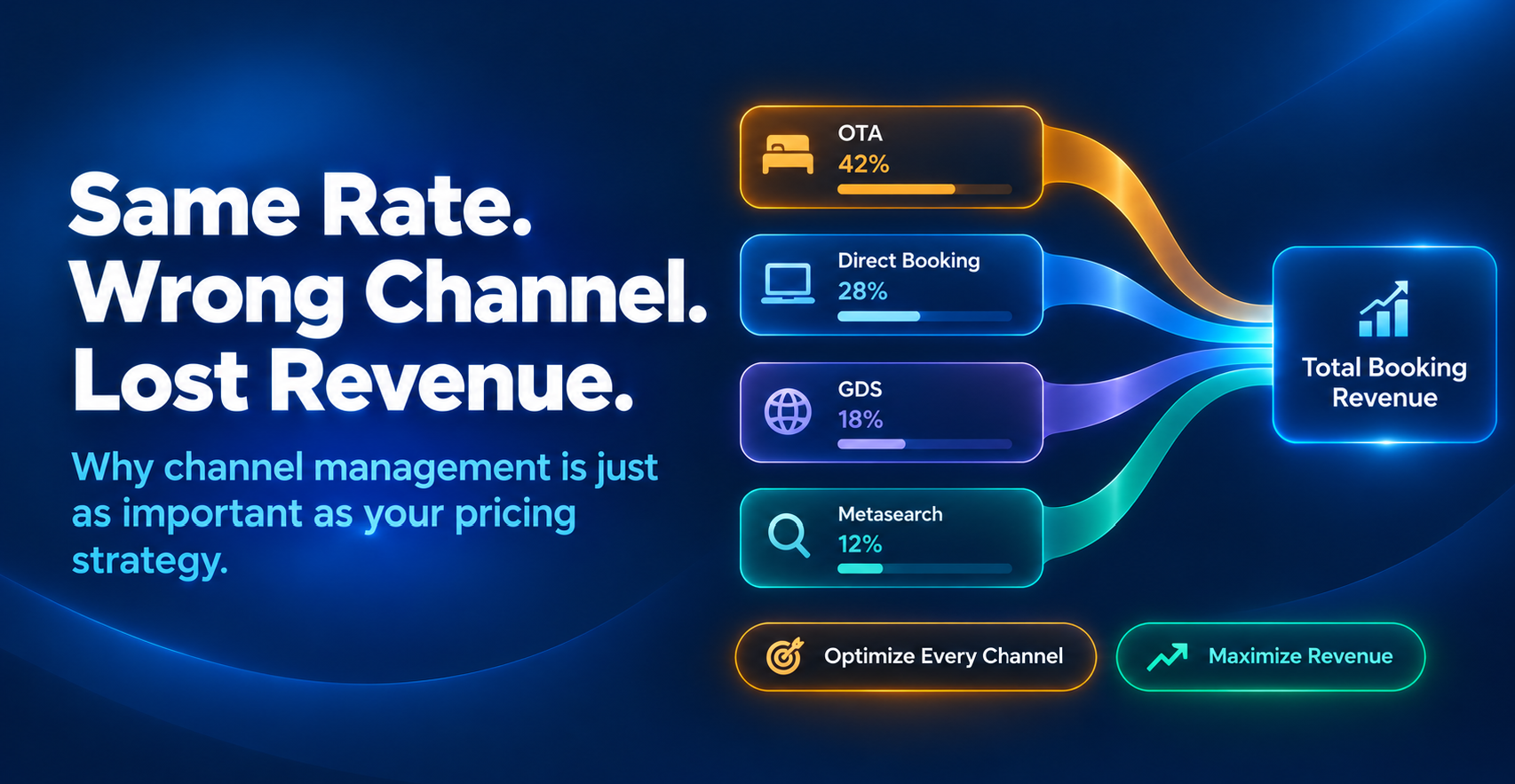
Why Your Hotel Needs a Channel Management Strategy, Not Just a Rate Strategy
Hotel channel management is one of the most overlooked levers in hotel revenue management. Most hotels spend significant time getting their rates right and far less time thinking about where and how those rates reach guests. The result is a pricing strategy that works in isolation but underperforms in distribution. This guide breaks down why hotel channel management strategy matters just as much as pricing, and what hotels can do to take control of it.
Why Rate Strategy Alone Is Not Enough for Hotel Revenue Management
A strong rate is only as good as the channel it appears on. A hotel can have perfectly calibrated dynamic pricing and still lose revenue if an OTA undercuts that rate, a high-value channel misses it, or the right guests can't see it at the right time.
Rate strategy answers the question of what to charge. Hotel channel management strategy answers where to sell, to whom, and at what distribution cost. Both questions matter and for most hotels, the second one gets far less attention than it deserves.
What Hotel Channel Management Actually Means
Hotel channel management is the active process of managing where your inventory is sold, how your rates appear across those channels, and how distribution costs are balanced against revenue.
For most hotels, channels include:
- The hotel’s own direct booking website
- OTAs such as Booking.com and Expedia
- The brand website for branded properties
- Global Distribution Systems (GDS) for corporate and travel agent bookings
- Metasearch platforms such as Google Hotel Ads and TripAdvisor
Each channel comes with a different cost, a different guest profile, and a different level of control over your rate and brand. A hotel channel management strategy decides how to use each one, not just whether to be listed on it.
How Poor Hotel Channel Management Costs Hotels Revenue
Without an active hotel channel management strategy, hotels tend to fall into patterns that quietly erode profitability.
Over-reliance on OTAs. OTAs are a valuable source of visibility, but they come with commission costs that reduce the revenue your hotel actually keeps from each booking. Hotels that rely heavily on OTAs for the majority of their bookings are paying a significant share of their revenue back in commissions for business they could have captured more cheaply through other channels.
Rate parity violations. Rate parity means selling your room at the same rate across every channel at the same time. When parity breaks — whether intentionally or through a manual update error — OTAs can end up displaying a lower rate than your own website, which both undermines guest trust and trains bookers to go to the OTA first. Research shows that in the majority of hotel rate searches, at least one OTA is displaying a lower price than the hotel’s direct website — a problem that compounds over time if left unmanaged.
Invisible on high-value channels. Many hotels are well-represented on the major OTAs but absent from channels that carry higher-value guests — corporate travel platforms, GDS connections, or metasearch. A hotel channel management strategy ensures you are visible where the right guests are looking, not just where it was easiest to get listed.
What a Strong Hotel Channel Management Strategy Looks Like
A strong hotel channel management strategy is not about being on every channel. It is about being on the right channels, with the right rates, and actively managing performance across all of them.
Know your cost of distribution by channel. Every channel has a different cost — OTA commissions, GDS fees, direct booking incentives. Understanding what each booking actually costs your hotel is the starting point for deciding where to prioritize inventory and where to pull back.
Actively manage rate parity. Rate parity does not manage itself. Rate updates that go live on one channel before others create the exact mismatches that damage your direct booking position and your OTA relationships. A channel manager that syncs rates and availability in real time across all channels removes that risk.
Balance OTA visibility with direct booking growth. OTAs drive discovery and visibility. The goal is not to eliminate OTA business but to use it strategically — capturing visibility from OTAs while converting repeat and high-intent guests to direct bookings where distribution costs are lower.
Monitor channel performance regularly. Which channels are driving bookings? At what ADR? At what cost? Reviewing channel performance as part of your regular hotel revenue management routine tells you where to invest and where to pull back — and surfaces problems before they compound.
Rate Parity and Why It Matters
Rate parity is the practice of selling the same room at the same rate across every channel, direct and third-party, at the same time. It is written into most OTA contracts as a condition of staying listed — which means a parity violation is not just a revenue management problem, it is a contractual one.
Maintaining rate parity is harder than it sounds. Manual rate updates across multiple channels create windows where mismatches occur. A walk-in discount, a rate that goes live early on one channel, or an OTA that applies a discount program can all create parity violations without any deliberate action from the hotel.
The fix is a connected channel management system that updates all channels simultaneously — and a regular audit process to catch anything that slips through. Rate parity is not a one-time setup. It is an ongoing discipline that sits at the center of any hotel channel management strategy worth having.
The Takeaway: Channel Management Is Not Optional
Hotels that grow revenue consistently are not just the ones with the best rates. They are the ones that control how and where those rates reach guests — actively managing their hotel distribution, protecting rate parity, and balancing OTA business with direct booking growth.
A rate strategy without a channel management strategy is half a plan. The hotels that put both together are the ones that keep more of the revenue their pricing strategy earns.
At Atica, we actively manage third-party channels for hotels — maximizing visibility, optimizing channel performance, and maintaining rate parity so your hotel drives more bookings while protecting ADR.
Want to know how Atica helps your hotel take control of its channel management strategy?
